

Noah.
Noah Built the Ark
Almost everyone can answer this one. Far fewer people know how long it took. By the timeline in Genesis the build may have run to something close to a century. For every year of it, the sky looked completely ordinary.
Who built the ark?
👉 Noah.
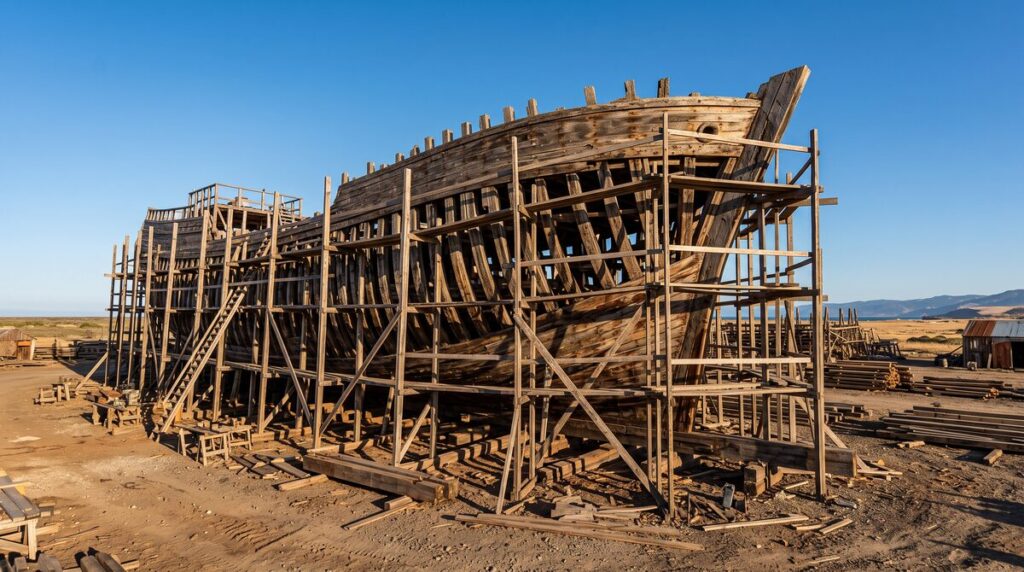
A hundred years of work with nothing to point at
The instructions are in Genesis 6. They are oddly specific for a story people think of as vague.
Length, width, height. Three decks. One door in the side. A roof. Cypress wood, sealed inside and out with pitch.
It came out at roughly 450 feet long in modern terms. That is longer than a rugby field by half again. It was built to float and nothing else. There is no mast in the description, no rudder, no oars. It was never meant to go anywhere. It only had to stay up.
The timeline is where it gets strange.
Genesis gives Noah’s age at two fixed points, and the gap between them is around a hundred years. The text does not say the whole century went on the build. It does leave the reader with a very long stretch of time and one enormous unfinished object sitting in it.
For all of that time there was no evidence. No unusual weather. No sign in the sky. Neighbours who presumably walked past the thing for decades.
The part the rainbow version skips
Most retellings stop at the rainbow, and that is a genuinely good ending. It is not the actual one.
The flood recedes. Everyone comes out. The very next thing Genesis records is that Noah planted a vineyard. He made wine, drank too much of it and passed out in his tent. What follows is a messy family episode that ends with him cursing one of his grandsons over it.
It is an uncomfortable few verses and they are usually left out of the children’s version, for obvious reasons.
They are also the reason the story is not a hero legend. The man who spent a century on the most disciplined project in the book is the same man in that tent, about a chapter later. The text does not tidy him up or explain him. It just reports both and moves on.
What we can take from this
Most of the work that matters gets done before there is any evidence it was needed.
That is the actual difficulty in this story, and it has nothing to do with animals.
Anyone can keep going once the rain starts. The hard part is the ninety-something years before it. All you have is the instruction. All anyone else can see is a very large object that has never yet been useful.
Almost everything worth building has a stretch like that in the middle. The years of practice before anyone hears you play. The long patch of a job where the work is real and the results are not visible to anybody outside it. Saving for something nobody else believes you will get to.
There is no way to prove you were right during that stretch. That is what makes it hard, and it is why most things are abandoned in the middle rather than at the start.
The vineyard afterwards is worth keeping too. Finishing something enormous did not turn him into a different sort of person. It rarely does.
One thing worth sitting with
He had one door and a fixed amount of room, and the text says the door was shut from outside.
Genesis never records Noah saying anything about the people who did not get on. Not a protest, not a word. Whether that silence is obedience or something colder is left entirely open.
Something on near you
Long, unglamorous, unwatched work is mostly what holds a community together.
Walkn on Water lists 980 churches across 23 regions, nearly all of them running on exactly that. Find one near you