

Samson
Samson: The Strongman of Israel
Samson is one of the most famous and fascinating characters in the Old Testament — a man given extraordinary, superhuman strength by God who could defeat armies, tear apart a lion with his bare hands, and perform incredible feats no ordinary person could. His strength came with a condition: he had been set apart from birth under a special vow to God, and his hair was never to be cut as a sign of that vow. The strength wasn’t really in his hair — it came from God — but the hair represented his commitment and obedience.
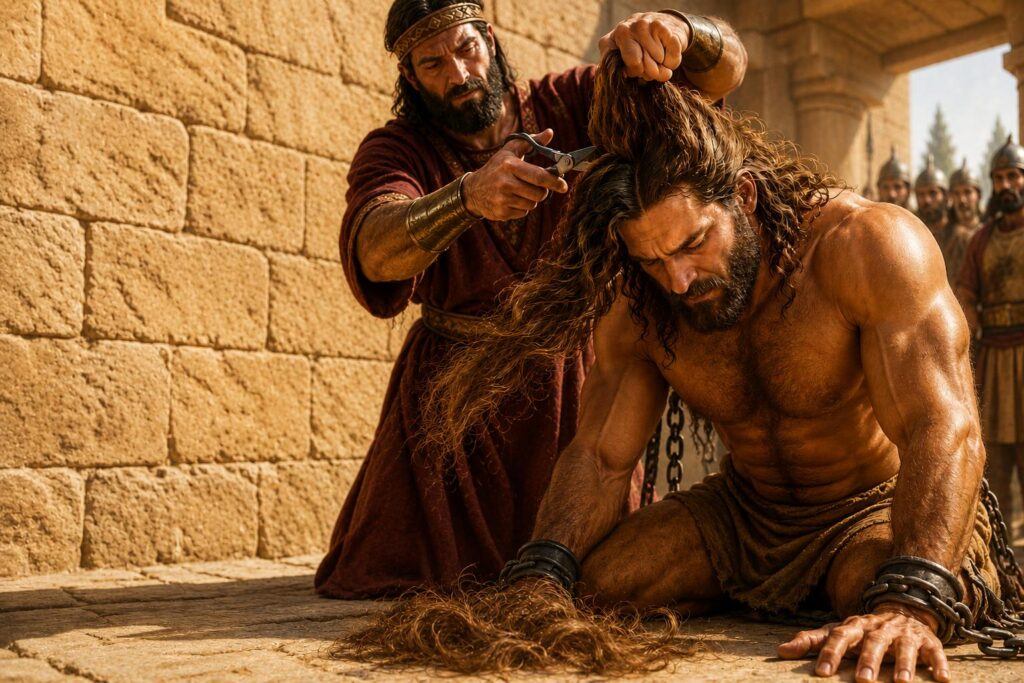
Over time, Samson was betrayed by Delilah, who discovered the secret of his vow. While he slept, his hair was cut. When he woke, his strength was gone, and he was captured, blinded, and imprisoned by his Philistine enemies. But in the final moments of his life, Samson turned back to God. His strength was restored one last time, and he brought down a Philistine temple, defeating more enemies in his death than in his life. You can read the full story in Judges 13–16.
Who was the super-strong guy who lost his power because of a haircut?
👉 Samson.
Deeper Context and Interesting Facts
The Nazirite Vow
The vow Samson lived under is called a Nazirite vow (from the Hebrew nazir, meaning “consecrated” or “separated”). It’s described in Numbers 6 and had three main rules:
- No cutting the hair — a visible sign of consecration
- No wine, grapes, or anything from the vine — abstaining from indulgence
- No contact with dead bodies — avoiding ritual impurity
What makes Samson unusual is that most Nazirite vows were temporary and self-chosen. Samson was a Nazirite from the womb — his vow was lifelong, declared by an angel before he was even born. Other lifelong Nazirites in scripture include Samuel and (according to tradition) John the Baptist.
Samson actually broke parts of his vow throughout his life — he ate honey from the carcass of the lion he killed (touching the dead) and likely drank at the feast in Judges 14. The hair was the last piece of the vow still holding, which is partly why losing it was so significant.
The Historical Setting
Samson lived during the period of the Judges — roughly 1200–1000 BCE — a chaotic time before Israel had kings. The book famously summarises the era with the line that everyone did what was right in their own eyes.
His enemies, the Philistines, were a sea-faring people who had settled along the coastal plain of Canaan (around modern Gaza and Ashkelon). They had iron weapons and chariots, giving them a major military advantage over the Israelites. Samson was raised up as a judge to begin delivering Israel from Philistine oppression, though he never finished the job — that fell to David generations later.
Wild Feats and Strange Stories
Samson’s exploits read more like mythology than typical biblical narrative:
- Killed a lion with his bare hands on the way to visit a Philistine woman (Judges 14)
- Caught 300 foxes, tied torches to their tails, and set them loose in Philistine grain fields
- Killed 1,000 men with the jawbone of a donkey (Judges 15)
- Tore the city gates of Gaza off their hinges and carried them up a hill
- Posed riddles at his own wedding feast — the only riddle contest in the Bible
He’s also one of the few biblical figures with a real sense of humour, often taunting his enemies in verse.
Delilah and the Betrayal
Delilah’s name has become shorthand for a treacherous lover, but the text is surprisingly sparse about her. We don’t know if she was Philistine or Israelite, and unlike Samson’s earlier wife, she’s not described as someone he loved being married to — just someone he loved. The Philistine lords paid her 1,100 pieces of silver each (a massive sum) to find the secret of his strength.
She asks him three times, and three times he lies — bowstrings, new ropes, weaving his hair into a loom. The fourth time, worn down by her nagging, he tells the truth. There’s something almost tragic and self-destructive about it: he seems to know what’s coming and tells her anyway.
Themes and Interpretations
Samson’s story works on several levels:
As a flawed deliverer — he’s vain, impulsive, ruled by his appetites, and yet God still uses him. He’s a reminder that biblical heroes are rarely tidy moral examples.
As a symbolic figure — some scholars see solar imagery in Samson (his name Shimshon relates to shemesh, “sun”), with his long hair as rays and his blinding as the setting sun. Whether intentional or borrowed from older Near Eastern motifs, the symbolism is striking.
As a tragic hero — his arc parallels Greek tragedy: a man of extraordinary gifts undone by his own weakness, finding redemption only in death. John Milton wrote an entire tragic poem about him called Samson Agonistes (1671).
As a foreshadowing — Christian tradition has often read Samson as a type of Christ: betrayed, mocked, and through his death defeating his enemies and saving his people.
Cultural Legacy
Samson has inspired an enormous amount of art and storytelling — Rembrandt, Rubens, and Caravaggio all painted scenes from his life; Handel wrote an oratorio (Samson, 1743); Saint-Saëns composed the opera Samson et Dalila; and Cecil B. DeMille directed a famous 1949 film. He’s even arguably an ancestor of every “strongman with a fatal weakness” trope in modern fiction — Superman and kryptonite included.